Soluble dietary corn fiber is moving from a niche ingredient to a practical tool for reducing sugar and increasing fiber. Grand View Research’s 2024 Dietary Fibers Market report estimates continued global growth through 2030. However, market forecasts differ by region, application, and definition. That uncertainty matters when selecting suppliers.
The sourcing process should begin with a clear product specification. Confirm fiber content, moisture, sweetness, solubility, viscosity, and tolerance limits. Request a current certificate of analysis for every production lot. It should include microbiological results, heavy metals, pesticide residues, and allergen information. Traceability should reach the corn source and processing facility. Small details matter. A clean, dry powder should flow evenly from the bag, without clumps or an unusual odor.
Regulatory review is equally important. The U.S. Food and Drug Administration sets a 28-gram Daily Value for dietary fiber based on a 2,000-calorie diet. EFSA’s scientific opinion also supports approximately 25 grams of fiber daily for healthy adults. These references help teams evaluate nutrition claims, but they do not replace local legal review. Suppliers should explain whether their soluble dietary corn fiber is produced through enzymatic processing, hydrolysis, or another method. Documentation should support the intended food application.
Cost alone can mislead. A lower price may reflect weaker testing, inconsistent purity, or limited technical support. Compare delivered cost, yield, functionality, and supply continuity. I would also request pilot samples for beverages, nutrition bars, or baked products. Performance on paper is not always performance in a factory. The best supplier is not necessarily the largest one; it is the one that can prove consistency, transparency, and responsible manufacturing.
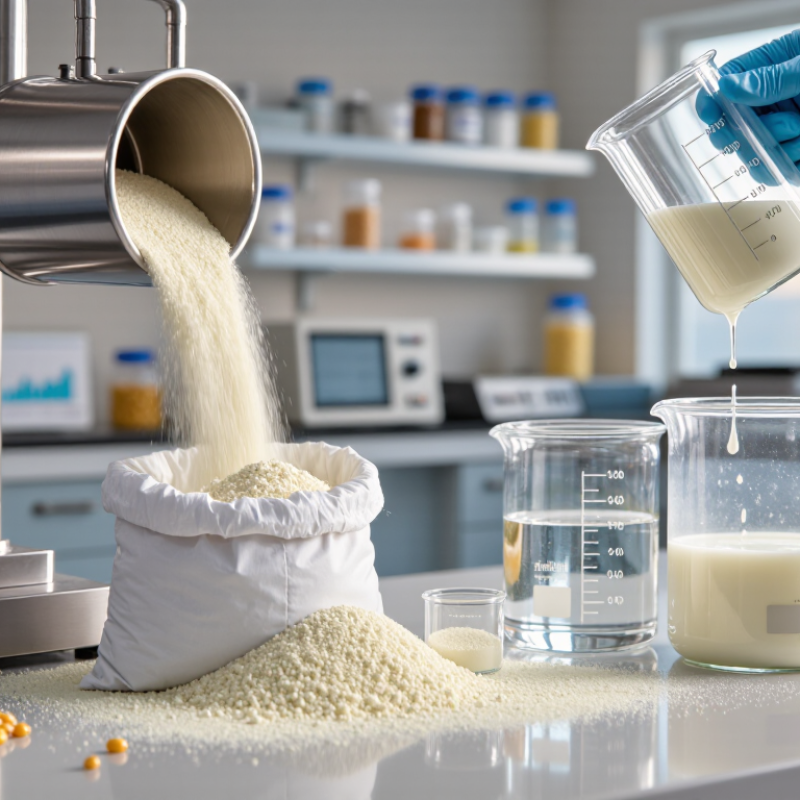
What Is Soluble Dietary Corn Fiber?
Soluble dietary corn fiber is a purified carbohydrate fiber made from corn starch. It dissolves in water and usually has a mild taste, making it suitable for beverages, nutrition bars, baked goods, and reduced-sugar formulas. It is not the same as ordinary cornmeal. Its structure resists complete digestion in the small intestine, allowing part of it to reach the colon.
The 2023 World Health Organization healthy diet guidance recommends at least 25 grams of naturally occurring dietary fiber daily for adults. This gap creates practical interest in added fibers. Soluble corn fiber can increase fiber content without adding much sweetness or changing texture dramatically. However, formulation results depend on purity, molecular structure, processing temperature, and serving size. Small details matter.
When sourcing it, request a current specification sheet, certificate of analysis, allergen statement, microbiological results, and dietary-fiber testing method. Confirm whether the supplier measures fiber using an approved analytical method, such as AOAC procedures. Ask about residual sugars, moisture, ash, and batch consistency. A clean white powder is useful, but appearance alone proves little. I have found that a supplier’s technical response often reveals more than a sales sample. Still, one test batch is not enough. Soluble fiber may cause digestive discomfort when intake rises too quickly, so product trials should include realistic serving conditions and clear consumer instructions.
How to Define Your Sourcing Requirements
How to Source Soluble Dietary Corn Fiber: How to Define Your Sourcing Requirements
A reliable sourcing brief starts with the finished product, not a supplier’s brochure. Define the required fiber level, sweetness, viscosity, solubility, color, and application temperature. For beverages, test clarity after 24 hours at refrigerated conditions. For baked foods, measure water binding after heating. Small details matter.
The World Health Organization and FAO recommend at least 25 grams of dietary fiber daily for adults, based on their expert consultation report. This supports strong consumer demand for fiber-enriched foods, but it does not define your ingredient specification. Require an assay based on a recognized AOAC method, such as AOAC 2009.01 or an applicable equivalent. Ask for moisture, ash, pH, particle size, and microbiological limits. Include the test method, not only the target number.
Be precise about documentation. Request a certificate of analysis for each lot, allergen status, origin statement, non-GMO declaration where relevant, shelf-life evidence, and storage conditions. Packaging should protect the powder from moisture; a damaged inner liner can change handling performance quickly. Confirm whether the supplier controls corn sourcing, processing, and final release testing.
Do not over-specify too early. Our first draft once demanded an exact color range that added cost without improving the formula. That was unnecessary. A better process compares three trial lots under identical conditions. Record dispersibility, mouthfeel, sweetness, and sediment after one hour and seven days. Leave room for revision. Specs should protect quality, not create paperwork.
Where to Find Qualified Corn Fiber Suppliers
Qualified corn fiber suppliers should be evaluated beyond price and online claims. USDA’s 2024/25 Grain: World Markets and Trade report estimates global corn production at approximately 1.2 billion metric tons. Supply is abundant, but quality can still vary sharply between processors. Ask for the exact fiber source, production country, carrier ingredients, and manufacturing flow. A clear technical data sheet should state dietary fiber content, moisture, ash, sweetness, solubility, and recommended applications.
Request recent certificates of analysis from several production lots. Check fiber testing methods, especially whether the supplier uses an accepted AOAC method. Results should include microbiological limits, heavy metals, pesticides, and allergen controls. FDA guidance on dietary fiber emphasizes that isolated fibers require appropriate characterization and labeling support. This makes transparent documentation essential.
A reliable supplier can provide lot-level traceability within hours, not days. Look for HACCP systems, recognized food-safety certification, change-control procedures, and a documented recall process. Request samples from different lots, then test dispersion in your actual beverage or nutrition formula. Observe sediment, cloudiness, viscosity, and taste after storage. Small details matter.
FAO’s Food Outlook reports continued pressure on global grain supply chains, with weather and logistics affecting availability. Therefore, assess backup production sites and minimum stock policies. One weakness remains: public market reports often group soluble corn fiber with broader dietary fibers. Direct comparisons can be imperfect. I would also question unusually low prices. They may reflect different purity, testing, or service levels, rather than a better offer.
How to Source Soluble Dietary Corn Fiber?
Suggested qualification priorities for evaluating soluble dietary corn fiber suppliers
This illustrative 100-point sourcing framework emphasizes verified product quality, regulatory documentation, and food-safety controls before commercial capacity and continuity. Buyers should confirm specifications through current certificates of analysis, laboratory testing, audits, and applicable local regulations.
How to Evaluate Quality, Safety, and Compliance
Sourcing soluble dietary corn fiber starts with a clear specification, not a low price. Define fiber content, solubility, color, moisture, particle size, and sweetness before requesting samples. A practical benchmark is AOAC 2009.01 or AOAC 2011.25 testing, which measures dietary fiber more comprehensively than older methods. Ask for three recent test results, not one perfect certificate.
Safety needs documented control at every step. Request batch traceability from corn origin to finished powder, plus tests for Salmonella, E. coli, yeast, mold, heavy metals, mycotoxins, and pesticide residues. Corn-based materials may also require allergen statements and genetically modified organism declarations, depending on the destination market. The FAO and WHO expert report recommends 20–30 grams of dietary fiber daily for adults, but this does not prove every fiber ingredient supports a health claim. Claims must match local rules.
Compliance is where sourcing often becomes uncomfortable. FDA labeling requirements, European Union food regulations, and Codex guidance do not always use identical definitions or claim conditions. Review the supplier’s food safety plan, HACCP records, certificate of analysis, and change-control procedure. I would also test an incoming lot independently. A polished COA can still miss variation between batches. Solubility may change after storage, especially in humid warehouses. That detail is easy to overlook. A supplier should explain failures openly, with corrective actions and retained samples, rather than simply promising consistency.
How to Compare Offers and Finalize Procurement
Sourcing soluble dietary corn fiber is not just a price exercise. A procurement team should compare usable fiber, not only the quoted kilogram rate. Request the current specification, assay method, moisture, ash, color, odor, microbiological limits, and allergen statement. Ask whether these values apply to the delivered lot. Keep retain samples. This matters when a pale powder arrives in sealed bags but dissolves slowly in a pilot beverage. In my experience, small solubility differences can create larger formulation costs. Good paperwork does not always predict factory behavior.
Build a comparison sheet with five columns: delivered cost, technical fit, documentation, supply capacity, and payment terms. Convert every offer to the same basis, including freight, applicable duties, testing, and expected loss. Check the minimum order quantity against actual consumption. A low price can become expensive when inventory sits for months. Request a recent certificate of analysis and one representative sample. Test before committing. Run a controlled bench test at the intended use level. Record mixing time, sediment, sweetness impact, and batch appearance. Do not rely on one attractive trial.
Before finalizing procurement, confirm lead time, lot traceability, packaging integrity, change-notification rules, and complaint response procedures. Put agreed specifications into the purchase contract, not only email. Clarify approval steps for substitutions or process changes. Document every variance. A short call with quality and production staff can expose practical gaps. Consider a trial order with defined acceptance criteria. This may feel slower, but it protects the launch. One weakness remains: supplier data can be accurate yet incomplete. Recheck critical values after arrival.
How to Source Soluble Dietary Corn Fiber? - How to Compare Offers and Finalize Procurement
| Evaluation Dimension |
Target / Requirement |
Offer A |
Offer B |
Offer C |
Offer D |
Procurement Comment |
| Product form |
Free-flowing powder |
Powder |
Powder |
Powder |
Powder |
Confirm particle size and handling characteristics before production trials. |
| Source material |
Corn-derived |
Corn |
Corn |
Corn |
Corn |
Request a statement covering raw-material origin and processing method. |
| Total dietary fiber |
≥ 85% |
85.4% |
88.7% |
90.2% |
86.1% |
Higher fiber concentration can reduce the quantity required per finished-product serving. |
| Moisture |
≤ 6.0% |
4.8% |
4.1% |
3.7% |
5.2% |
Lower moisture generally supports better storage stability, subject to packaging and warehouse conditions. |
| Total sugars |
≤ 5.0% |
2.6% |
1.8% |
1.4% |
3.1% |
Verify the analytical method and whether the value is guaranteed or typical. |
| pH, 10% solution |
4.0–7.0 |
5.2 |
5.5 |
5.8 |
5.0 |
Confirm compatibility with the finished product and other ingredients. |
| Microbiological specification |
Food-grade limits |
Compliant COA |
Compliant COA |
Compliant COA |
Compliant COA |
Require batch-specific results for total plate count, yeast and mold, coliforms, and pathogens. |
| GMO status |
Declared and documented |
Non-GMO statement |
Non-GMO statement |
Non-GMO statement |
Declaration pending |
Do not accept an unsupported marketing claim; request a formal declaration and traceability records. |
| Allergen statement |
Required |
Provided |
Provided |
Provided |
Provided |
Review shared-facility controls and cross-contact risks, not only the ingredient declaration. |
| Food-safety certification |
Recognized GFSI scheme preferred |
Valid certificate |
Valid certificate |
Valid certificate |
Audit scheduled |
Check certificate scope, site address, expiry date, and product coverage. |
| Packaging |
Moisture-resistant food-grade bags |
20 kg bags |
25 kg bags |
20 kg bags |
25 kg bags |
Select a pack size that balances warehouse handling, moisture protection, and consumption rate. |
| Shelf life |
≥ 24 months unopened |
24 months |
24 months |
30 months |
24 months |
Define storage temperature, humidity, and first-expiry-first-out requirements in the purchase specification. |
| Minimum order quantity |
≤ 1,000 kg for trial order |
500 kg |
1,000 kg |
2,000 kg |
500 kg |
A smaller trial MOQ reduces qualification risk before committing to commercial volume. |
| Quoted price |
Compare on equivalent Incoterm |
USD 2.35/kg, FOB |
USD 2.55/kg, FOB |
USD 2.80/kg, FOB |
USD 2.20/kg, FOB |
Compare landed cost after freight, duty, insurance, testing, handling, and payment terms. |
| Standard lead time |
≤ 6 weeks |
4–5 weeks |
5–6 weeks |
6–8 weeks |
3–4 weeks |
Confirm production capacity, shipping schedule, and contingency arrangements. |
| Sample and pilot support |
Required before approval |
1 kg sample; technical data |
2 kg sample; formulation support |
1 kg sample; limited support |
2 kg sample; pilot support |
Run dispersion, taste, viscosity, stability, and finished-product sensory tests before approval. |
| Payment terms |
Risk-balanced terms |
30% advance / 70% before shipment |
20% advance / 80% against documents |
50% advance / 50% before shipment |
Net 30 after delivery |
Negotiate payment against agreed documents and retain remedies for non-conforming batches. |
| Overall procurement assessment |
Pass quality, cost, and supply review |
Shortlist |
Preferred |
Conditional |
Shortlist |
Select the preferred offer only after document verification, sample approval, landed-cost confirmation, and a signed quality agreement. |
Procurement note: All commercial figures are expressed in USD and should be normalized to the same specification, packaging basis, currency, Incoterm, shipment size, and delivery destination. Before issuing a purchase order, verify the current certificate of analysis, food-safety documentation, allergen and GMO statements, product specification, sample performance, and batch-release requirements.
FAQS
Define fiber content, sweetness, viscosity, solubility, color, particle size, and application temperature. Test the finished product. For beverages, check clarity after 24 hours under refrigeration. For baked foods, measure water binding after heating.
Request a lot-specific certificate of analysis, allergen statement, origin declaration, non-GMO statement where relevant, and storage conditions. Ask for shelf-life evidence. The certificate should list testing methods, not only target values.
Request samples from at least three production lots. Test them in the same beverage or food formula. Record dispersion, mouthfeel, sweetness, sediment, viscosity, and cloudiness after one hour and seven days. Small differences matter.
Ask for results covering microbial limits, heavy metals, mycotoxins, pesticide residues, moisture, ash, and pH. Testing should use recognized dietary fiber methods. One perfect report is not enough.
The supplier should connect each finished lot to its corn origin, processing records, packaging, and release tests. Traceability should work within hours. Days create doubt.
Powder packaging should resist moisture and protect the inner liner. A damaged liner can quickly affect handling and dispersion. Confirm warehouse humidity, storage temperature, shelf life, and retained-sample practices. Humidity is easy to miss.
No. Overly narrow specifications can add cost without improving the formula. Compare trial lots before fixing exact color or performance limits. Specifications should protect quality, not create paperwork.
Ask whether the price reflects different purity, testing, packaging, or service levels. A lower quote may hide weaker documentation or limited backup supply. Cheap is not automatically efficient.
The supplier should explain the failure, provide corrective actions, and preserve samples for investigation. Independent incoming testing is wise. Promises are not evidence.
No. Fiber content does not automatically prove a permitted health or nutrition claim. Check the destination market’s labeling rules and claim conditions. Rules can differ.
Conclusion
Soluble dietary corn fiber is a versatile, plant-based ingredient valued for its fiber content, mild taste, and compatibility with a wide range of food and beverage applications. When sourcing it, buyers should first define clear requirements, including fiber concentration, processing method, particle size, solubility, flavor profile, intended use, packaging format, order volume, and delivery schedule. These specifications create a practical basis for identifying suitable suppliers and requesting accurate quotations.
Qualified suppliers can be found through industry networks, ingredient exhibitions, professional directories, and direct manufacturer outreach. Each candidate should be evaluated through documentation, sample testing, quality certifications, traceability systems, allergen controls, and compliance with applicable food regulations. When comparing offers, consider more than the listed price: review product consistency, minimum order quantities, lead times, technical support, payment terms, and logistics reliability. A well-structured supplier assessment and sample approval process can help secure a safe, compliant, cost-effective, and dependable source of Soluble dietary corn fiber.