Direct factory sourcing solutions offering superior nitrogen solubility, non-GMO credentials, and exceptional organoleptic profiles for functional food and sports nutrition manufacturing.
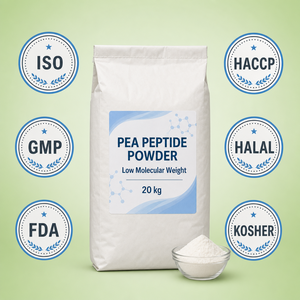
Pea protein, derived primarily from yellow field peas (Pisum sativum), has emerged as the global cornerstone of clean-label, hypoallergenic plant-based nutrition. Driven by consumer avoidance of dairy allergens (lactose, whey protein concentrate) and soy phytoestrogens, institutional procurement officers and formula designers are increasingly specifying yellow pea protein isolate (PPI) for ready-to-mix (RTM) powders, meat alternative analogs, extrusion snacks, and clinical nutrition systems.
From an industrial manufacturing perspective, the functional utility of pea protein is governed by its fractionated chemical composition—comprising globulins (legumin, vicilin, and convicilin) and albumins. Modern processing facilities utilize either wet-milling membrane separation or dry air-classification to harvest these proteins:
Yields high-purity isolates (80% to 90% dry basis). Yellow peas are steeped, ground, and subjected to solubilization at alkaline pH (8.0–9.0), followed by centrifugation to remove starch and insoluble fibers. The soluble protein is then precipitated at its isoelectric point (pH 4.5), washed, neutralized, and micro-spray dried. This process yields exceptional emulsification and gelling capabilities.
Produces short-chain oligopeptides with high water solubility (NSI > 90%) and low viscosity. Enzymatic cleavage breaks hydrophobic polypeptide chains, significantly reducing the classic "earthy" or "beany" off-notes while accelerating gastrointestinal peptide absorption. Hydrolyzed pea peptides are ideal for clear liquid sports beverages and elderly nutrition.
Pea protein isolate features a exceptionally rich Branched-Chain Amino Acid (BCAA) profile, specifically high concentrations of L-Leucine, L-Isoleucine, and L-Valine, which rival whey protein for muscle protein synthesis (MPS). Furthermore, its high L-Arginine content (approx. 8.7g per 100g protein) supports nitric oxide synthesis and vascular endothelial health. While naturally lower in sulfur-containing amino acids (methionine and cysteine), blending pea protein isolate with brown rice or pumpkin seed protein achieves a fully complete amino acid profile with a Protein Digestibility-Corrected Amino Acid Score (PDCAAS) of 1.0.
A comprehensive assessment of leading global manufacturers based on annual tonnage, extraction technology, purity range, and global compliance certifications.
| Manufacturer / Exporter | Primary Location | Extraction Technology | Purity Range | Key Certifications | Core Application Specialty |
|---|---|---|---|---|---|
| 1. Roquette Frères | France / Canada | Wet Isoelectric Extraction | 80% – 85% | ISO22000, FSSC22000, Kosher, Halal | NUTRILYS® RTM Drinks |
| 2. PURIS Foods | United States | Proprietary Low-Heat Wet Milling | 80% – 85% | USDA Organic, Non-GMO Project | Neutral Taste Extrusions |
| 3. Yantai Shuangta Food Co. | China | Fermentation & Membrane Separation | 80% – 90% | BRCGS, HACCP, Halal, Kosher | High-Volume Global Export |
| 4. Cosucra Groupe Warcoing | Belgium | Physical Water-Based Extraction | 84% – 88% | FSSC22000, Non-GMO Project | PISTANE® Meat Analogs |
| 5. Cargill (PURIS Partner) | Global / USA | Membrane Filtration System | 80% – 85% | SQF Level 3, USDA Organic | Industrial Food Systems |
| 6. Essex Sencillo Sourcing Network | North America / Asia | Enzymatic Hydrolysis & Isolate | 80% – 95% | ISO9001, Halal, Kosher, GMP | Consolidated MOQs & OEM |
| 7. Axiom Foods | United States | Low-Heat Chemical-Free Fractionation | 80% – 90% | USDA Organic, Halal, Kosher | Vegotein™ Sports Nutrition |
| 8. Shandong Jianyuan Group | China | Biological Fermentation & Wet Extract | 80% – 85% | ISO22000, IP Non-GMO | Texturized Plant Protein |
| 9. Emsland Group | Germany | Mechanical Separation & Hydro-Thermal | 80% – 84% | IFS Food, BRC, Kosher | Emulflow® Confectionery |
| 10. AGT Food & Ingredients | Canada | Dry Air-Classification & Wet Mill | 60% – 85% | FSSC22000, HACCP, GMP+ | Pulse Flour & Concentrates |
As the market for plant-based nutrition matures, B2B buyers must navigate key technological shifts and supply chain evolutions to secure high-performance raw materials.
Traditional pea protein isolates often suffered from gritty mouthfeel and volatile hexanal off-flavors. Advanced micro-jet particle size reduction (down to 200–300 mesh) combined with thermal vacuum deodorization allows formulators to achieve ultra-smooth suspension in ready-to-drink (RTD) dairy alternatives without masking agents.
Targeted cleavage of intact pea globulins into low-molecular-weight peptides (<1000 Da) enhances water solubility across acidic pH ranges (pH 3.0 to 4.5). This innovation unlocks new product categories such as clear protein waters, high-protein energy gels, and isotonic sports recovery drinks.
Due to soil bioaccumulation of heavy metals (Lead, Cadmium, Arsenic, Mercury), leading international buyers require strict batch-level ICP-MS validation. Exporters who implement ion-exchange purification to maintain Lead levels under 0.2 ppm are capturing premium brand partnerships.
Managing modern food ingredient supply chains requires overcoming fragmented vendor landscapes, high minimum order quantities (MOQs), volatile transit schedules, and burdensome administrative overhead. Partnering with a consolidated ingredient sourcing distributor bridges the gap between major global primary processing factories and local plant production lines.
Rather than issuing separate purchase orders to multiple ingredient producers, buyers can consolidate pea protein isolates, hydrocolloids, starches, emulsifiers, and flavor carriers into one purchase order. By leveraging bulk inventory reserves, manufacturers access lower minimum order quantities (MOQs), reducing working capital tie-up.
Formulating with pea protein requires balancing gelling capacity, water-binding capacity, and flavor stability. Technical applications teams work directly with corporate R&D scientists to select the exact mesh size, solubility index, and blend ratios needed to optimize physical stability and sensory appeal.
Providing rapid regional delivery across Maine, New York, Pennsylvania, New Jersey, Maryland, and nationwide.
Essential guidance for purchasing agents, quality control specialists, and product development managers evaluating pea protein supplies.
Pea Protein Isolate is produced via mechanical wet-milling and precipitation, retaining intact globular proteins with high emulsification properties and an 80% to 85% protein concentration. Hydrolyzed Pea Protein undergoes enzymatic cleavage to break protein chains into short peptides, elevating protein content up to 95% while drastically increasing water solubility (NSI > 90%), reducing viscosity, and eliminating grassy flavor off-notes.
Pea protein isolate is an exceptional candidate for High-Moisture Extrusion Cooking (HMEC) and Low-Moisture Extrusion. Its globulin fractions unfold under thermal shear stress, cross-linking to form fibrous, muscle-like textures ideal for plant-based burgers, sausages, and chicken alternatives. When blended with high-amylose starches or wheat gluten, it provides authentic bite resistance.
Tier-1 factories must supply batch-specific Certificates of Analysis (CoA) confirming protein content (Kjeldahl/Dumas method N x 6.25), micro-biological counts (TPC, Yeast & Mold, E. coli, Salmonella), heavy metal limits (Pb, Cd, As, Hg), ISO 22000 or FSSC 22000 food safety management, Halal certification, Kosher certification, and IP Non-GMO statements.
Yes. Through our consolidated distribution network, food and beverage manufacturers can purchase pallet-level (LTL) quantities of premium pea protein isolate alongside other required ingredients (such as hydrocolloids, starches, and fibers). This eliminates the strict 20-foot or 40-foot container MOQ requirements typical of direct overseas factory purchases.
Off-notes stem primarily from lipid oxidation products like hexanal and 1-octen-3-ol. Top exporters utilize advanced water washing, thermal deodorization, dynamic membrane filtration, and micro-jet milling to remove free lipids and volatile compounds. R&D teams also employ natural masking flavors or blend with complementary proteins to achieve neutral taste profiles.
Connect directly with our technical sourcing specialists to receive comprehensive product specification sheets, Certificates of Analysis (CoA), sample kits, and real-time container/pallet pricing.
Get Catalog